
PostNord - Senior Concept Developer and Service Designer
Rethink parcel sendings from lockers
PostNord wanted to improve the locker-to-network sending journey by reducing friction for senders while improving operational efficiency and scalability across Nordic markets using emerging AI-enabled technologies
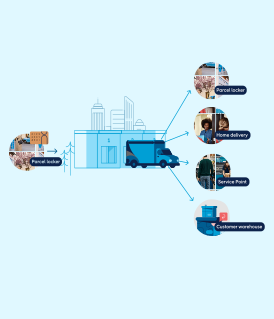
Problem / challange today
PostNord had already enabled label-free locker drop-off for returns, creating a simple experience for consumers. But beneath that simplicity sits a production flow designed for high-throughput barcode scanning. When parcels enter the network without a printed label, the process becomes more manual, requiring relabelling and extra handling that risks slowing throughput and increasing operational cost.
My role
Discovery lead and concept design. I helped the team move from ambiguity to shared direction, balancing what customers and consumers need with what the operation can reliably handle at scale.
What I owned across the work:
- Framing the problem and defining success metrics
- Planning and running discovery across consumer adoption, customer needs, technology and operations feasibility, and competitor/trend benchmarking
- Mapping end-to-end journeys to uncover friction points, failure modes, and cost drivers
- Developing and comparing two future-state concepts, including responsible uses of AI-enabled identification
- Aligning with Engineering, Operations, Data, and Product on feasibility, scalability, cost drivers, and change implications
- Delivering a recommendation with trade-offs, risks, and a phased next-step plan
Problem framing
Problem statement
Consumers benefit from label-free locker drop-off, but PostNord’s production flow still depends on barcode scanning. We need an approach that preserves the seamless label-free experience while enabling efficient, reliable processing at scale across terminals and markets.
How I framed the problem
How Might We - Discovery focus
Enable consumers to send parcels via lockers as smoothly as possible, while maintaining delivery quality and operational cost efficiency, using new AI-enabled technologies?
North Star
First-time-right label-free processing rate (percentage of label-free parcels processed end-to-end without manual intervention).
Supporting metrics
Consumers benefit from label-free locker drop-off, but PostNord’s production flow still depends on barcode scanning. We need an approach that preserves the seamless label-free experience while enabling efficient, reliable processing at scale across terminals and markets.
How I framed the problem
- Capture what we know, and don’t know (discovery need)
- Map the current journey
- Define the core problem
- Generate HMW
- Agreed about Nort star metrics
How Might We - Discovery focus
Enable consumers to send parcels via lockers as smoothly as possible, while maintaining delivery quality and operational cost efficiency, using new AI-enabled technologies?
North Star
First-time-right label-free processing rate (percentage of label-free parcels processed end-to-end without manual intervention).
Supporting metrics
- Time-in-terminal for labelless parcels (median vs labelled baseline)
- Locker utilisation (or labelless drop-off volume share)
Assess New Technologies and Operational Feasiblity
Goal: Evaluate emerging technologies that could enable label-free sending at scale and assess whether current and future production flows could support it efficiently and reliably.
Methods: Running Tech PoC with vendors for ICR and digital fingerprinting, feasibility discovery through mapping production flows, identifying dependencies and failure modes, and aligning through stakeholder workshops.
Key takeaways that shape decisions
Methods: Running Tech PoC with vendors for ICR and digital fingerprinting, feasibility discovery through mapping production flows, identifying dependencies and failure modes, and aligning through stakeholder workshops.
Key takeaways that shape decisions
- High identification accuracy is achievable: Both handwritten-code ICR and camera-based “fingerprinting” can reach ~98–99% accuracy when each parcel includes a unique identifier added by a pen from the consumer.
- Throughput impact is the main uncertainty: Identification may slow processing in tunnels and sorting, so live testing is needed to validate performance at scale.
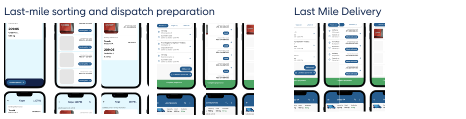
- IT feasibility looks solid, but operations is the bottleneck: The biggest risks sit in the operational flow, especially terminal space constraints, sorting for delivery, and last-mile delivery.
Service Blue Print

Customer Needs, Expectations & Pain Points
Goal: Returns and marketplaces will likely champion locker-based sending, so we needed to understand their commercial expectations, operational concerns, and pilot readiness.
Method: Semi-structured interviews with customers to surface needs, risks, and success criteria for parcel locker sendings.
What we learned:
Key Insight shared by Customers about Consumer Preferences & Behavior
Key Insight shared by Customers about Operational challanges
Opportunity areas mentioned
Key takeaways that shape decisions
Method: Semi-structured interviews with customers to surface needs, risks, and success criteria for parcel locker sendings.
What we learned:
Key Insight shared by Customers about Consumer Preferences & Behavior
- QR codes at service points: Many top sellers appreciate QR codes for easy drop-off
- Accessibility vs preference: Choice between parcel lockers and service points is mainly driven by accessibility and price, not just preference
- Anonymity: Very important for the sender to be anonymous
Key Insight shared by Customers about Operational challanges
- Issues with locker handling: Common mistakes like closing the door before placing the parcel.
- Labelless process misunderstanding: Consumers don’t realize the code must be generated before visiting the locker causing frustration.
Opportunity areas mentioned
- Multiparcel sendings via lockers
- Use parcel lockers without delivery
Key takeaways that shape decisions
- Customer interviews, supported by broader market and consumer insights, indicate that locker-based sending is expected and will increasingly be a baseline offering. However, adoption is primarily driven by two factors: lower cost for the customer and greater flexibility for consumers (when, where, and how they send and receive parcels).
Consumer Experience & Adoption
Goal: Understand which label-free sending experiences feel most intuitive, trustworthy, and simple for consumers, while still being scalable in production.
Method: Concept testing and evaluation using clickable low-fi Figma prototypes and Wizard-of-Oz sessions, plus survey-based discovery and validation.
Method: Concept testing and evaluation using clickable low-fi Figma prototypes and Wizard-of-Oz sessions, plus survey-based discovery and validation.
Some key insight from the survey
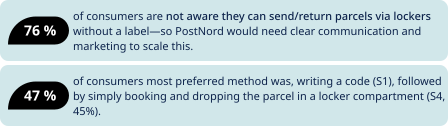
Concept testing scenarios: Each scenario was tested with and end-to-end experience in real world enviroments.
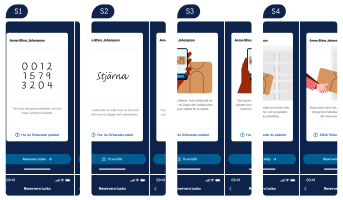
Key takeaways that shape decisions
- Highest trust: Survey and concept testing consistently showed that writing a code feels like the most secure and reliable option. People trust that the parcel can be identified and traced.
- Familiar mental model: A visible identifier matches how consumers expect parcels to work. “Something on the parcel” is a deeply ingrained expectation.
- Good balance of ease and security: It’s not as frictionless as doing nothing, but it still feels easy when the basics are in place (clear instructions and a pen available).
- Lower perceived risk: Compared with photo-based solutions or fully anonymous drop-offs, a written code reduces confusion and the perceived risk of mistakes.
Competitors and Trends
Goal: Understand what “good” looks like today, identify emerging patterns, and clarify where PostNord can differentiate by benchmarked end-to-end locker sending experiences, and assessed trends like image recognition and AI-assisted identification.
Benchmark example: Stampfree.ai enables label-free shipping using a handwritten, AI-validated code and links shipment data before handover.
Benchmark example: Stampfree.ai enables label-free shipping using a handwritten, AI-validated code and links shipment data before handover.
How Stampfree.ai works
- Stampfree.ai enables label‑free shipping using a handwritten, AI‑validated code generated via browser, app, or WhatsApp
- Senders write the code on the parcel and validate it with their phone camera; AI links all tracking data before handover
- At lockers, consumers scan once, deposit multiple parcels, each visibly marked with its own validated ID
- Carriers scan the codes on collection, retrieve shipment data, and can print labels later if needed.
- Benefits for consumers: visible tracking ID without printing; simple, digital, and convenient
- Benefits for carriers: lower handling costs, support for same‑day label‑free home pickups, and elimination of locker printer maintenance

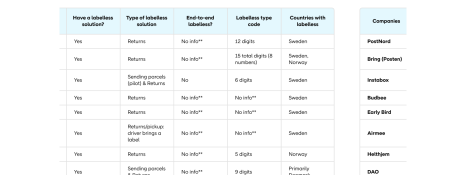
Competitor analysis
Key takeaways that shape decisions
Labelless sending is becoming essential for staying competitive in both sending and returns. No competitor currently offers a fully end‑to‑end labelless flow, though it’s unclear whether this is a strategic choice or a limitation. Bring uses longer numeric codes than PostNord, but concept testing showed no issues using shorter codes, but as always simpler remains better.
Labelless sending is becoming essential for staying competitive in both sending and returns. No competitor currently offers a fully end‑to‑end labelless flow, though it’s unclear whether this is a strategic choice or a limitation. Bring uses longer numeric codes than PostNord, but concept testing showed no issues using shorter codes, but as always simpler remains better.
Next Step Recommendation
We brought together insights from multiple discovery tracks with IT effort estimates, operational feasibility from journey mapping, and Nordic scalability considerations to build a concrete near-term plan toward two alternative future visions—balancing what’s best for consumers and customers with what’s realistic and valuable for the business.
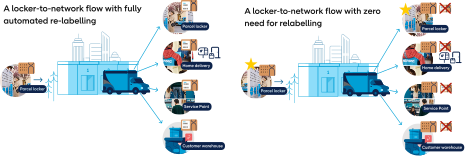
Near-tearm plan
We presented a clear near-term roadmap, using backcasting to turn the future vision(s) into practical first steps. The plan covered technology implementation, live testing in real operations, and ongoing concept validation to ensure the experience works for customers and scales for the business. For each vision, we designed the concepts and made the trade-offs transparent, focusing on investment needs, scalability across Nordic markets, and both IT and operational feasibility.
We presented a clear near-term roadmap, using backcasting to turn the future vision(s) into practical first steps. The plan covered technology implementation, live testing in real operations, and ongoing concept validation to ensure the experience works for customers and scales for the business. For each vision, we designed the concepts and made the trade-offs transparent, focusing on investment needs, scalability across Nordic markets, and both IT and operational feasibility.
Operational concepts for Automated relabelling
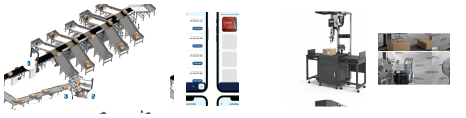
Operational concepts for Zero need of relabelling
People involved
Consumer Experience & Adoption
Discovery team: Oscar Nyblom, Mikaela Frisk + CX lead
Customer Needs, Expectations & Pain Points
Discovery team: Oscar Nyblom, Mikaela Frisk + CX lead, Product lead, Customer Relationship
Technical & Operations Proof of Concept
Operation feasibility: Discovery team: Oscar Nyblom, Mikaela Frisk, Ravi Kiran Kotty (Tech PoC lead), Product lead, Process lead
Tech / IT Feasibility: Ravi Kiran Kotty (Tech PoC), Product lead, EA, System architects for the consumer app and operational IT systems.
Steering Group
Cost leadership program lead, Market leadership program lead, Cheif IT Production Parcels, Cheif Technology acceleration
Discovery team: Oscar Nyblom, Mikaela Frisk + CX lead
Customer Needs, Expectations & Pain Points
Discovery team: Oscar Nyblom, Mikaela Frisk + CX lead, Product lead, Customer Relationship
Technical & Operations Proof of Concept
Operation feasibility: Discovery team: Oscar Nyblom, Mikaela Frisk, Ravi Kiran Kotty (Tech PoC lead), Product lead, Process lead
Tech / IT Feasibility: Ravi Kiran Kotty (Tech PoC), Product lead, EA, System architects for the consumer app and operational IT systems.
Steering Group
Cost leadership program lead, Market leadership program lead, Cheif IT Production Parcels, Cheif Technology acceleration