Article · November 2026
Are we designing better experiences, or just improving the ones we already have?
As designers, we spend a lot of time improving existing experiences. Simplifying flows, removing friction, reducing steps and making interfaces easier to use.
And that’s important work.
But I’ve often wondered whether we’re sometimes too focused on improving the experience in front of us, rather than questioning whether it needs to work that way at all.
Are we solving the customer’s problem, or just making it easier to navigate the solution we’ve already built?
Having spent many years working with early-stage, technology-driven products, I’ve learned to stay curious about what new technology makes possible.
Whenever something new emerges, my first thought is rarely just how we can use it to improve an existing feature. I’m more interested in what it allows us to do differently.
And sometimes, that means questioning whether the experience we’ve designed is needed at all.
What if we didn’t need the app?
Whenever iOS or Android introduces new capabilities, I tend to explore what has become technically possible and what it might mean for people’s everyday experiences.
- Widgets made information accessible without opening an app.
- Live Activities made it possible to follow a delivery directly from the Lock Screen.
- App Clips reduced the need to download an entire app for a quick interaction.
And now, with Siri, Google Gemini and AI-powered interactions, we’re seeing possibilities for people to accomplish things without navigating traditional interfaces.
These changes might seem small individually. But together, they challenge an assumption we’ve designed around for years: that people need to enter our products and follow our journeys to get something done.
If someone can accomplish their goal without going through the journey we’ve designed, should that journey still exist?
Of course, removing interactions isn’t always better. Sometimes people need reassurance, information or a sense of control.
The interesting design challenge is understanding which interactions actually create value, and which exist simply because of how we’ve built our services.
From improving the journey to rethinking it
I explored this through a simple concept.
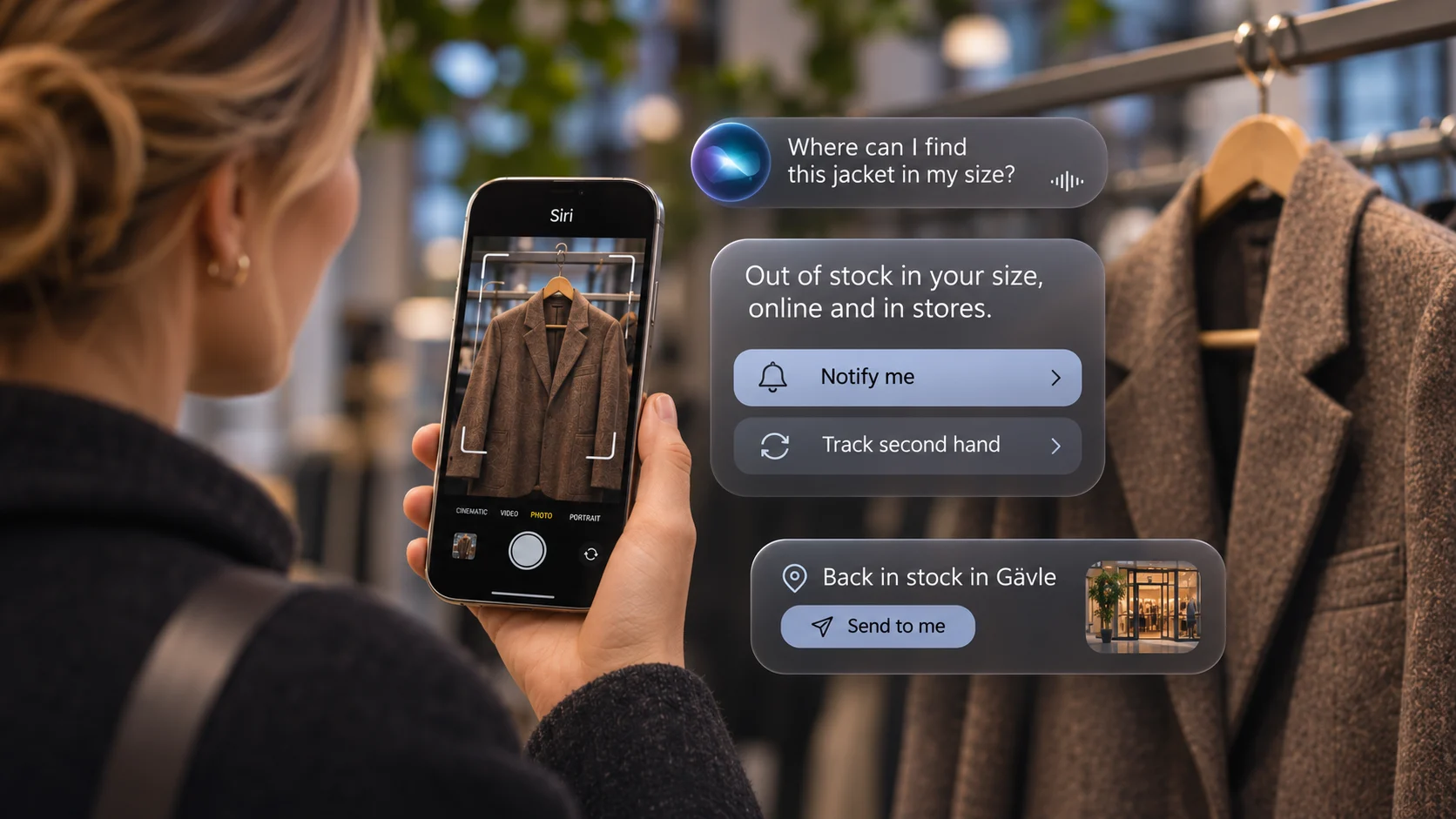
Imagine a customer in a clothing store. She finds a wool blazer she loves, but not in her size.
What would a better experience look like?
- 5/10She opens the retailer’s app, searches for the blazer and tries to order it for home delivery, only to discover it’s out of stock.
- 6/10She can save the blazer in the app and receive an email when it’s available again.
- 7/10She takes a photo of the blazer. The app recognises it and immediately shows availability in her size.
- 9/10She asks Siri instead. The blazer is sold out, but Siri offers to keep an eye on it and notify her when it’s back.
- 10/10Siri also offers to search trusted second-hand marketplaces.
- 11/10A few days later, the blazer becomes available in her size at another store. She receives a notification and can arrange delivery directly, without opening the app or repeating her search. A Live Activity lets her follow the delivery.
But is 11/10 really better just because more happens automatically?
Not necessarily.
What interests me isn’t the AI, the voice interaction or the notification.
It’s that the relationship between the customer and the service starts to change.
At 5/10, the customer has to find the product, check availability and figure out what to do next.
At 11/10, she expresses what she wants once. The service remembers, looks for opportunities and helps her take the next step when something becomes relevant.
And perhaps we could take that further.
What if the service understood more than which blazer she wanted? Maybe she needs it for an upcoming event, prefers second-hand or has a budget she doesn’t want to exceed.
With her permission, the service could consider those preferences, explore relevant options and suggest a next step.
She would still decide whether to buy. But she wouldn’t need to manage every step along the way.
We’re moving from designing journeys people have to navigate towards designing services that help people achieve their goals.
That also changes what we need to design.
Not just screens and interactions, but how a service understands someone’s intention, earns their trust, explains what it’s doing and knows when to act.
And importantly, when to leave the decision to the person.
This is a concept, not a validated solution. We’d still need to explore whether people want this kind of assistance, what they trust a service to do and where they want to remain in control.
Because the experience with the most automation isn’t necessarily the best one.
A better experience may require changing more than the interface
The blazer is a relatively simple example, but making that experience work would require much more than designing a new interaction.
Product information, inventory across stores, second-hand availability, customer preferences and delivery services would all need to work together.
Sometimes the biggest opportunity to improve the experience lies in changing what happens behind the interface.
I’ve seen this challenge in different forms in my own work.
At TRR, we explored how AI could help jobseekers understand how their experience matched a role and tailor their CVs, potentially helping them get that first interview.
But the design challenge wasn’t only about generating better CV suggestions.
It was about helping people understand and communicate their experience with confidence, without losing their own voice. How could we make AI suggestions useful and understandable while keeping the person in control of what they shared?
At PostNord, we investigated whether AI and changes to logistics processes could make label-free parcel sending more scalable, from the first mile to the last.
Removing a printed label sounds like a small customer improvement. But delivering that experience at scale required us to look beyond the interaction itself and understand the technical and operational dependencies throughout the logistics process.
Both experiences reinforced something I’ve learned through years of working with technology-driven products:
Rethinking the customer experience often means looking beyond the screen, and sometimes beyond the product itself.
What changes in the way we design?
I still believe in the fundamentals of human-centred design: understanding people’s needs, identifying problems worth solving, exploring ideas, prototyping, testing and learning.
Those fundamentals haven’t changed.
The design process with emerging technology
The steps stay the same. What new technology adds to each one:
Understand people’s needs
Emerging tech: Spot what new capabilities make possible
Identify problems worth solving
Emerging tech: Ask which steps could disappear
Explore ideas
Emerging tech: Explore more ideas, faster, with AI
Prototype
Emerging tech: Build working prototypes in code
Test with people
Emerging tech: Test assumptions earlier, including trust and control
Learn and improve
Emerging tech: Decide whether to use the technology at all
Then round again, with what we learnt.
But the possibilities for how we explore ideas are changing.
Experimentation has always been an important part of how I work, especially after spending many years in early-stage technology companies where we often had to explore ideas before knowing exactly what the solution could look like.
Today, I’m experimenting with Claude, Markdown files and reusable skills to move from ideas to working prototypes and keep iterating on them. It’s also making me rethink the role Figma plays in my process.
What interests me isn’t just that I can build something faster.
It’s that I can explore more alternatives, make ideas tangible earlier and discover things I might not have noticed when working only with static designs.
A working prototype can expose questions about behaviour, context and technical feasibility that are difficult to explore through screens alone.
But speed comes with a risk.
Just because we can build something quickly doesn’t mean we’ve identified the right problem. And a convincing prototype can make an untested assumption feel more certain than it really is.
So perhaps the biggest value of these tools isn’t simply that they help us move faster.
It’s that they give us more opportunities to question our ideas, challenge our assumptions and learn before committing to a solution.
The opportunity and the responsibility
Emerging technology opens up possibilities to rethink products, services and entire customer journeys.
But it also introduces new questions for us as designers.
- What should a service remember?
- What should it be allowed to do on someone’s behalf?
- How should it explain its decisions?
- And when is an interaction important because it gives someone confidence or control?
- Not every interaction should disappear.
- Not every process needs AI.
- And not every technically possible experience is one people will actually want.
For me, the interesting work happens where curiosity about technology meets human needs.
Exploring what has become possible, making ideas tangible, testing whether they’re valuable and understanding what needs to change to make them work in practice.
Because perhaps the most important question isn’t how we can design the existing experience more efficiently.
It’s whether we’re designing the right experience in the first place.
Thinking about this too?
Shall we make something good together?
If you’re exploring what emerging technology could mean for your customers, or wondering whether an experience needs rethinking rather than improving, I’d love to talk.
- Rethinking experiences
- Prototyping with AI
- Product and design leadership
