CX/UX Discovery · PostNord · Concept development
Sending parcels without a label: towards a scalable logistics flow
I explored how AI and changed logistics flows could make label-free parcels scalable in PostNord’s parcel lockers. Through research, flow mapping, technical validation and concept development, I produced two future solution alternatives and a basis for decision on continued development.
- Year
- 2025
- Industry
- Logistics
- Company
- PostNord
- Scope
- 5 months
The short version
The problem
Consumers could send a parcel from a locker without a label. Behind that simple experience, the production flow still depended on barcodes, which meant manual steps.
What I did
I was responsible for the discovery work: research, flow mapping, a technical proof of concept with specialists, and concepts tested with consumers and experts.
What it gave
Two evaluated future concepts and a concrete basis for decision for PostNord’s continued development.
The problem
PostNord had created a simple customer experience where consumers could leave a parcel in a parcel locker without printing and attaching a label. Behind that smooth experience, however, was a production flow that still depended on barcode scanning.
When parcels came in without a physical label, manual steps were needed for identification, relabelling and further handling, among other things. That increased the risk of errors, lengthened lead times and raised operating costs.
To scale, the whole flow has to work
For the service to scale, the whole flow needed to work efficiently: from the parcel locker and the terminal to sorting and final delivery.
The design challenge
How can we keep the simple, label-free experience for the consumer and at the same time reduce manual handling through the whole logistics chain?
The solution had to handle large parcel volumes, work in several markets and be integrated with existing terminal and sorting flows. At the same time, the possibilities of AI-based identification had to be weighed against technical reliability, operational risks and investments in the physical infrastructure.
Key design decisions
Four insights steered the work.
- Keep the simple customer experienceThe consumer should still be able to leave the parcel without a printer, a label or extra manual steps.
- Optimise the whole flowThe solution had to work through the whole logistics chain, not only at the parcel locker or in one single terminal step.
- Validate the technology earlyAI-based identification had to be tried technically before it could be judged a realistic alternative in production.
- Compare development pathsThe work was not locked to one solution. Two future concepts were developed, with different possibilities, risks and investment needs.
My contribution in the team
My role
I was responsible for the discovery work and led research, flow mapping and concept development. I brought the consumers’ needs together with operational and technical perspectives, to identify where AI could create value and which parts of the flow needed to change.
I visualised the current state, formulated future scenarios, developed and tested concepts, and compiled recommendations, risks and choices ahead of continued development.
The team
The work was cross-functional, with competences in customer experience, product, technology, AI and logistics operations. That collaboration was decisive for the solutions to be understandable for the consumer, technically possible and feasible in the operational environment.
How I took on the challenge
- Mapped the whole parcel flowI mapped the journey from the consumer handing in the parcel at the locker to collection, terminal handling, sorting and delivery. It showed where the simple customer experience created manual steps and operational risks further along the flow.Result A shared picture of the current state and the most important problems to solve.
- Gathered several perspectivesThrough research with consumers and internal experts I identified needs, behaviours, technical limitations and operational friction.Result Clear criteria for what a usable and feasible solution had to fulfil.
- Explored the possibilities with AITogether with technical specialists I investigated how AI could identify parcels and connect them to the right shipment data without a physical label. A technical proof of concept was used to assess possibilities and limitations.Result A better understanding of where AI could create value, and which technical uncertainties remained.
- Developed several AI conceptsI developed concepts for different ways to hand in, identify and handle label-free parcels. The concepts varied in how the consumer, the mobile phone, the parcel locker and the terminal flow were used.Result Several possible solution directions to compare before a larger investment.
- Tested through the whole logistics flowThe concepts were tested with consumers to evaluate different ways of handing in a parcel. They were also checked with technical and operational experts for how they would work at collection, terminal handling, sorting and delivery.Result Identified user needs, technical dependencies, manual steps and operational risks.
- Recommended a directionThe results were used to refine the alternatives and select two future concepts. I compiled a recommendation with next steps, risks and important trade-offs.Result A concrete basis for decision on continued validation and development.
The service blueprint, front stage and backstage
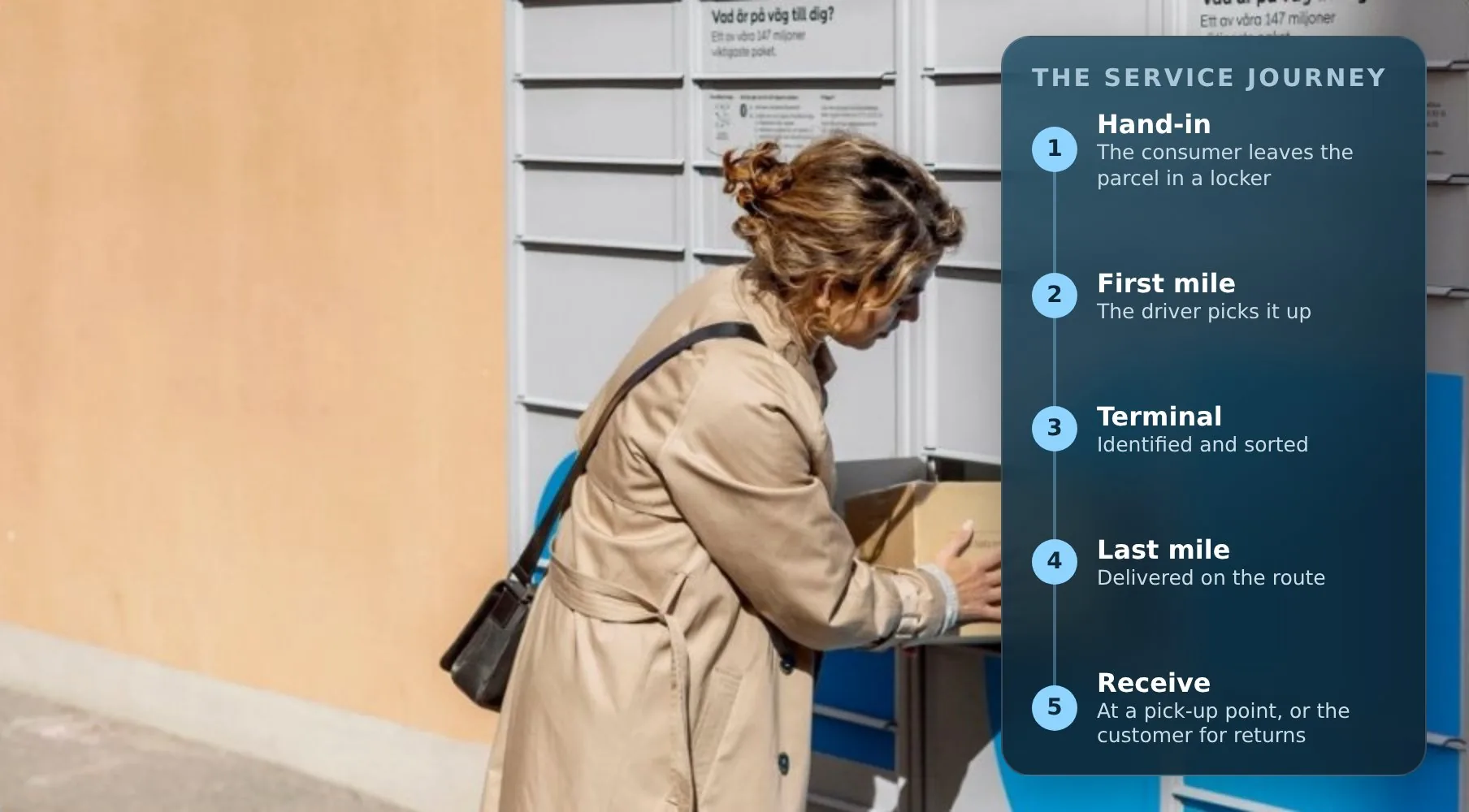
The label-free parcel flow: from the consumer leaving a parcel in a locker, through first mile pick-up and sorting at the terminal, to last mile delivery to a pick-up point, or directly to the customer when the parcel is a return.
Scroll sideways to see the whole blueprint.
The consumer experience
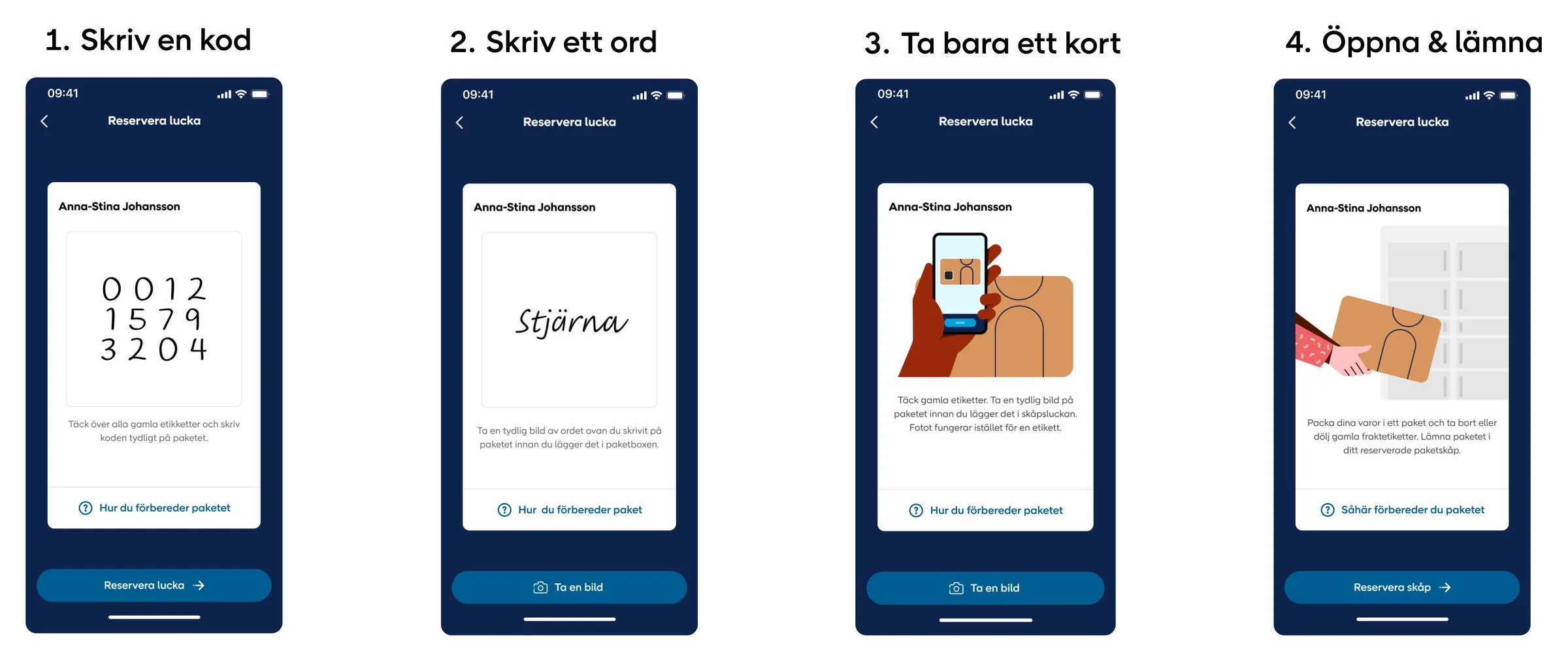
Image recognition through AI also opened up more possibilities for the consumer experience of sending a parcel from a locker than today’s handwritten code. I prototyped different user experiences for the flow of booking a locker to send a parcel, and tested them with users. We evaluated each experience on how safe it felt, how simple it felt and the overall experience. We also sent out a survey, so that our recommendation for the consumer experience was based on evidence.
The result
The work resulted in two evaluated future concepts and a concrete basis for decision for PostNord’s continued development.
The concepts made clear how AI and changed logistics flows could reduce manual handling while the simple customer experience was kept. They also made it possible to compare the alternatives by customer value, technical feasibility, operational impact and investment needs.
The recommendations made it possible to choose which solution tracks to investigate further, and which technical and operational questions needed answers before a larger investment.
What I took with me
A simple customer experience can move complexity to other parts of the service. To create a solution that works and can scale, the whole system has to be understood, from the consumer’s hand-in to terminal handling and delivery.
The project also showed the value of combining user insights, technical validation and operational knowledge before a direction is chosen and larger investments are made.